Question: How does a sailboater celebrate the 29th of February?
Answer: Visit the Turtle Hospital in Marathon (
http://www.turtlehospital.org/), the Shipwreck Museum (
http://www.shipwreckhistoreum.com/) and Mel Fisher Museum (
http://www.melfisher.org/) in Key West...and, of course, the mandatory pilgrimage to Mallory Square!
It was an interesting and full day. We returned to Key West to do some land touring and to act like several of the thousands of tourists who flock to this Margaritaville and madness mecca.
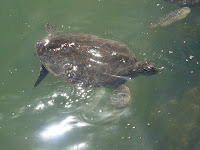
However, before we headed to Key West, we visited the Turtle

Hospital in Marathon. The hospital is a unique organization with a mission to rescue, rehabilitate, and release sea turtles that are injured either by the negligence of humans or by one of their natural predators...sharks, for example. Peggy was our guide and gave us a lecture to introduce us to sea turtles and the work of the hospital. Sea turtles are found in all the world's oceans except the Arctic Ocean. There are seven species of sea turtles: flatback, green, hawksbill, Kemp's Ridley, leatherback, loggerhead and olive ridley.
The leatherback is the only sea turtle that does not have a hard shell. Instead, it has a mosaic of bony plates beneath its leathery skin. The loggerhead is the largest of the sea turtles, measuring six or seven feet in length at maturity, three to five feet in width, and weighing up to 1300 pounds. Other species are smaller, for example, two to four feet in length.
A turtle is considered injured when it is found floating on the surface of the ocean and can't dive under. Anyone who spots a turtle in this condition...whether or not there is any other evidence of distress...can call the Turtle Hospital who will arrange to have the injured turtle brought to the hospital. The hospital receives as many as 70 injured sea turtles a year and has released more than 750 sea turtles to date. The hospital uses the services of a volunteer reptile vetrinarian and has the ability to perform surgery. There is even one turtle that is being fitted with a prosthetic device to replace the flipper lost to a shark
After an informative and interesting hour, we headed for Key West. Our

first stop was at the Turtle Kraals for lunch. The restaurant is located on the site of a green turtle "corral" which was once used to produce green sea turtle soup before the turtles became an endangered species. In retrospect, this was an interesting contrast…first we visited a place dedicated to the preservation of turtles and then we visited a place where turtles were slaughtered to make soup. Lunch was very good and turtle soup wasn’t on the menu! While we were eating a contingent of “suits” trooped in and sat at a table near us. At the same time, several armed Customs and Border Protection agents took up strategic positions surrounding the restaurant. Of course, Sarah couldn’t resist moving in on one agent and inquiring what was going on, who they were protecting, etc. I’m not certain she learned anything, but she did manage to get her photo taken with one of the agents!
After lunch we visited the Shipwreck Historeum where we learned the story of the Florida Keys

wreckers or shipwreck salvagers. The wreckers began their trade on Key West in the 1800s and made Key West one of the most prosperous location in the United States. In the mid-1800s ships were piling up on the reef at the rate of nearly one a week. The museum is a reconstruction of a wreckers warehouse containing items salvaged from the Issac Allerton which sank on the reef in 1856 and was the largest individual award by the federal court in Florida…or wrecking court…in the history of wrecking.
Above the warehouse/museum is a tower the wreckers used to keep a lookout for ships grounding on the reef. When a ship went aground on the reef, the cry from the tower of “Wreck Ashore” alerted the town and the race began to lay hands on the hull to claim salvage rights. The dark side of the humanitarian work of the wreckers is the rumor that some navigation lights were moved to mislead ships approaching the reef…now who would think of doing something like that?
The second stop on our touring itinerary was the Mel Fisher Treasure Museum which contains items salvaged from the wreck of the Nuestra Señora de Atocha (Our Lady of Atocha) which was the most famous of a fleet of Spanish ships that sank in 1622 off the Florida Keys while carrying copper, silver, gold, tobacco, gems, jewels, jewelery and indigo from Spanish ports in the Western Hemisphere. In 1622 the Atocha was driven by a hurricane onto the coral reefs near the Dry Tortugas.
In case you don’t remember the story, American treasure hunter Mel Fisher and a team of sub-contractors, funded by investors and others in a joint venture, searched for the Atocha for 16 and a half years; potential helpers were discouraged by the fact that this dangerous professional diving job was at minimum wage unless the ship was found. The Atocha wreck and its mother lode of silver, gold and emeralds was finally discovered in 1985. After the discovery, the U.S. government claimed title to the wreck, and the State of Florida seized many of the items retrieved by Mel Fisher. After eight years of litigation, the U.S. Supreme Court finally ruled in favor of Fisher and the items on display in the museum are owned by the Fisher family.
After we left the museum, we discovered a neat place we wish we had included on our itinerary…the Key West Museum of Art and History. It looks like it would have been an interesting tour, but it was closed when we discovered it and we had other things on our agenda. Actually, we missed a number of interesting things like President Truman’s Little White House, the Custom House Museum, the Key West Lighthouse Museum, the Butterfly and Nature Conservatory, etc. We did manage to snag a photo of a couple standing outside the door of the Art and History Museum and had our pictures taken with one of the more famous Key West celebrities...we think he wrote a story about an old man and a fish...probably true since he had a fishing rod in his hand when we found him!


It was now time for the Sunset Celebration at Mallory Square and we hurried to the bulkhead to take our place with several hundred close friends. Predictably, the sun set at the appointed time and the crowd went wild. Before and afterwards we walked around the square to catch a few of the street performers who work for tips…some of them even were talented. All were entertaining and since we were going to be in Key West to visit Dry Tortugas, we’ll probably drop by to see if we missed anything.
Perhaps we'll even be back to celebrate the next "Leap Year!"
One last item...on our way back to the car to return to Marathon, we stopped at the Key Lime Pie Factory (
http://www.blondgiraffe.com/) and bought a whole pie. After we got back to the boat, the three of us ate half of the pie with no apologies for our indulgence. It was wonderful and worth every calorie. It may even live up to its advertisement "Best Key Lime Pie in Key West and Florida...5 years in a row!"


 Later in the day we joined friends and fellow Whitby sailors, Pat,
  Greg and Judy for lunch at the No Name Pub (You Found It!) on...where else...No Name Key. We ordered our own pizza and had enough for two more meals on the boat.
 However, before we headed to Key West, we visited the Turtle
  Hospital in Marathon. The hospital is a unique organization with a mission to rescue, rehabilitate, and release sea turtles that are injured either by the negligence of humans or by one of their natural predators...sharks, for example. Peggy was our guide and gave us a lecture to introduce us to sea turtles and the work of the hospital. Sea turtles are found in all the world's oceans except the Arctic Ocean. There are seven species of sea turtles: flatback, green, hawksbill, Kemp's Ridley, leatherback, loggerhead and olive ridley.
 first stop was at the Turtle Kraals for lunch. The restaurant is located on the site of a green turtle "corral" which was once used to produce green sea turtle soup before the turtles became an endangered species. In retrospect, this was an interesting contrast…first we visited a place dedicated to the preservation of turtles and then we visited a place where turtles were slaughtered to make soup. Lunch was very good and turtle soup wasn’t on the menu! While we were eating a contingent of “suits” trooped in and sat at a table near us. At the same time, several armed Customs and Border Protection agents took up strategic positions surrounding the restaurant. Of course, Sarah couldn’t resist moving in on one agent and inquiring what was going on, who they were protecting, etc. I’m not certain she learned anything, but she did manage to get her photo taken with one of the agents!
 wreckers or shipwreck salvagers. The wreckers began their trade on Key West in the 1800s and made Key West one of the most prosperous location in the United States. In the mid-1800s ships were piling up on the reef at the rate of nearly one a week. The museum is a reconstruction of a wreckers warehouse containing items salvaged from the Issac Allerton which sank on the reef in 1856 and was the largest individual award by the federal court in Florida…or wrecking court…in the history of wrecking.


 We got serious about land touring today and stopped by the visitors center at Big Pine Key on the way to Key West to learn about what there was to offer us. This was our first excursion into the heart of the Conch Republic and we wanted to be certain we didn't miss anything. So, we picked up a handful of brochures and the first thing we learned was about the $200+ rooms in Key West. We decided Hotel Windreka was the best deal, so we planned to drive the 50 miles back to Marathon from the end of US1 and Mile 0.
 The first stop on our trip south was at
 the Florida Keys National Key Deer Refuge on Big Pine Key. The refuge is a federally protected habitat for a number of endangered creatures and plant life. Trivia question: The term "hammock" is used frequently to describe some locations. What does "hammock" mean? Answer: tropical hardwood forest...or at least that's what we think.
 After our stop at the Key Deer Refuge, we headed directly for Key
 West and stopped at the Welcome Center just off US1 on the northeast edge of town to enquire about a place to park, a place to eat lunch, and pick up a map. We found a garage at $10/day on the edge of the historic waterfront, parked and walked around the waterfront to
  find Alonzo's. After lunch we headed for an
  Old Town Trolley stop for a guided tour of the town to help us decide what we wanted to see when we returned tomorrow. We've had good experience with Trolley tours (http://www.historictours.com/) at other locations and the cost of the Trolley and the more famous Conch Tour Train was the same. Also, the Trolley tour consisted of one car full of people and the Conch Train tour consisted of several "train" cars full. We felt as if we got more personal treatment.
 After the Trolley tour, we headed for Mallory Square to scope out what
  the "Sunset Celebration" is all about. The Square is located on the northern edge of Duvall Street, facing the Gulf of Mexico where tourists can watch the sun setting each night. The tradition includes arts and crafts exhibitors, street performers, food carts, psychics, etc. beginning two hours before sunset. We don't know how long the celebration goes on since we left right after sunset to drive back to Hotel Windreka in Marathon. Maybe tomorrow when we return for some more touring we'll stay longer.
 Our next stop was to feed the Tarpon at Robbie's
  http://www.robbies.com/. At first we thought the Tarpon were penned up in tight enclosure to be harassed by Florida tourists trying to get close and personal. However, the Tarpon seem to gather around the dock pilings and hang out there during the day. Toward evening, the Tarpon all head out toward the channel to hunt for their dinner. Apparently, during the day, the Tarpon are fed by the tourists. When the tourists go home for the evening, the fish all head out to dine in the ocean. The next day the fish return to start the cycle again.
 Today we went out to the reef at Sombrero Key, about 4 miles south southeast of Vaca Key and the town of Marathon. The Sombrero Key Light is an iron-pile skeleton with a platform. The light is 142 feet above the water! The lighthouse is located on a mostly submerged reef. Old charts show a small island at the spot, but by the later 19th Century the island had eroded away, with some parts of the reef exposed at low tide. As a result, the reef and the lighthouse have also been called Dry Banks. The lighthouse was put in service in 1858...before Lincoln became President!
  The light was automated in 1960, and is still in operation. The foundation is iron pilings with disks, and the tower is a skeletal octagonal pyramid of cast iron. It is 142 feet tall and is painted brown. It has two platforms. The lower one, 15 feet above the water, held water and fuel tanks, the generator (after the light was electrified), boat hoists and a workshop. The upper platform, 40 feet above the water, held the quarters for the staff. The original lens, a first order Fresenel lens, is now on display in the Key West Lighthouse Museum. The Sombrero Key Light is the tallest lighthouse in the Florida Keys, and was the last lighthouse constructed under the supervision of Lieutenant George Meade of the Bureau of Topographical Engineers.
 The water was choppy and it wasn't a good day for snorkeling, but we enjoyed the experience in short bursts. Phil had the right idea and in between snorkeling runs, he enjoyed the sun on the trampoline of the dive boat.
 Even the Pelicans can be grumpy in this weather...
 We took our dinghy through the huge, tightly packed mooring field
  in Boot Key Harbor and ended up back at Docksiders for lunch. On the way back to Windreka, we detoured out the entrance channel and headed for Pigeon Key...or Cayo Paloma in Spanish...about 1.5 miles to the west. We spent a pleasant several hours on a guided tour of the island and its significance.
 The island is said to be named for large flocks of White-crowned
  pigeons which once roosted there. During the building of Henry Flagler's Overseas Railroad Key West Extension, a major construction depot was located there, the jumping off point for construction of the Seven Mile Bridge. A number of buildings from the Flagler era remain on the island. They are now part of the Pigeon Key Historic District. The island was originally only a slab of coral until the construction of the original railroad bridge when some 500 workers were housed and fed on the island until the railroad bridge was finished. You can read the story on the Wikipedia web site at: http://en.wikipedia.org/wiki/Pigeon_Key
 It was a smooth trip to Pigeon Key but a choppy return and we got soaked. However, the tour and time on the island was well worth it. We ended the day as we started it...looking out to the west and planning the next leg of our cruise to Key West. Earlier in the day there was a manatee chewing on the sea grass just behind Windreka and coming up for a breath of air before returning to his breakfast. The manatee was gone by sunset, but we didn't need anything more than to watch the sun setting on another pleasant day in the lower Keys.